ugcflows
How to track UGC brand deals when every brand pays differently
4 min readUGC Flows
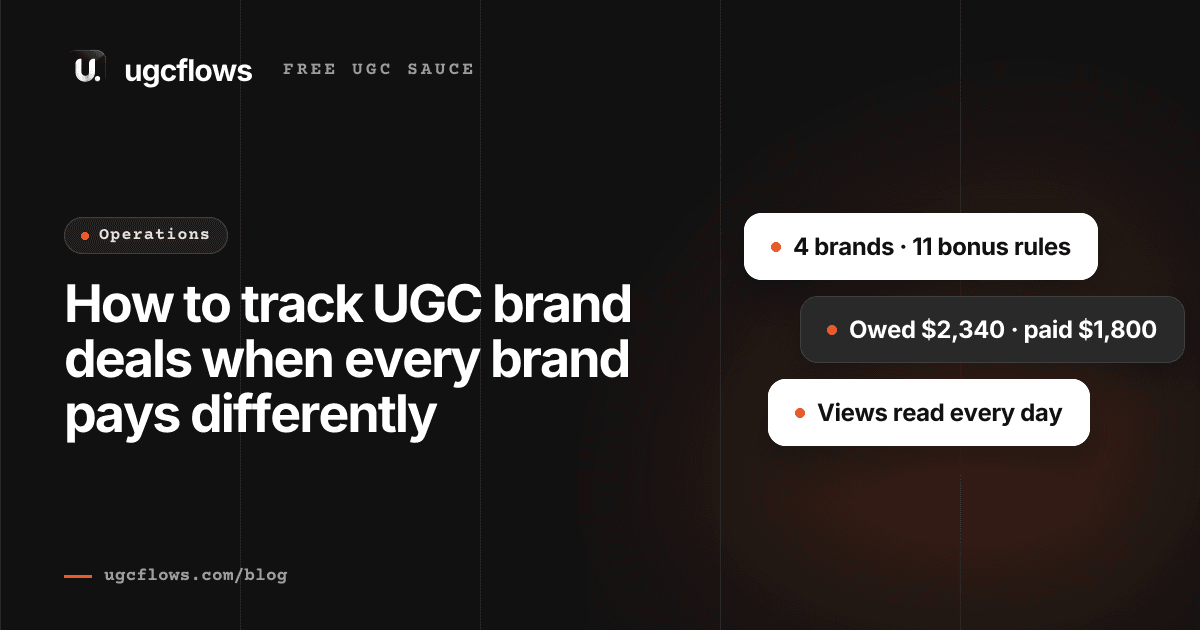
Track each deal as five things: the brand, the flat fee and its terms, every bonus rule with its window, one account per platform, and one view reading per video per day. A spreadsheet holds the first three and breaks on the last two.
Key takeaways
- A deal is five things, not one row: brand, fee and terms, bonus rules with windows, one account per platform, and a daily view reading per video.
- A bonus window is views at the end minus views at the start. One latest number cannot compute that.
- A day with no reading is not a day that earned nothing. Never subtract against a zero nobody measured.
- Earned is what the rules say is owed today. Paid is what landed. Keep both and freeze a payout the day it is logged.
- The spreadsheet breaks at the second brand, and by the third the bonus is being estimated rather than counted.
On this page
Why does the spreadsheet break at two brands?
One brand deal is a flat fee plus a bonus plus a set of accounts, and none of those is a single cell. A $1 CPM on the first 30 days of each video needs the view count on the day the video was posted and the count 30 days later, per video, per platform. A milestone at 100,000 views needs the highest tier reached, once, and must not pay twice. A campaign with fixed dates needs the views a video had before the campaign started subtracted out. By the second brand the sheet has three tabs and a formula nobody trusts, and by the third the bonus is being estimated rather than counted. The four bonus shapes themselves are in how much to charge for UGC.
What are the five things to track?
| Thing | What it holds | Why it is its own row |
|---|---|---|
| Brand | who is paying | two deals with one brand are one line on your 1099 |
| Deal | flat fee, pay cycle, net terms, minimum views for the base fee | a brand's second campaign is a second deal with different rules |
| Bonus rule | shape, rate, window, minimum, cap, which platforms | a deal can hold several, and each pays on its own window |
| Account | one per platform per deal | brands hand you new accounts, and views are counted per account |
| Video | the cut, the post on each platform, the date posted | one cut goes out on four platforms for one fee |
Why one view reading per day, not the latest number?
A bonus window is views at the end of the window minus views at the start. You cannot compute that from one number. If you only keep the latest count, an older video that joins a fixed-date campaign brings its whole back catalogue into the bonus, and a 30-day rule keeps paying forever. So the tracker keeps one row per video per day, and the window arithmetic reads the last reading on or before each edge.
Owed is not paid
Earned is what the rules say the brand owes as of today. Paid is what landed. Keep both, and freeze a payout the day it is logged: the numbers on it are text, never recomputed, and a correction is a new adjustment line rather than a change to a bill already sent. The gap between earned and paid, per brand, is the number that tells you who to chase, and how to invoice a brand for UGC is the bill that does the chasing.
How UGC Flows does it
It is on both plans, from $199 a month, and the editing marketplace beside it is $3 a video, or $2 a video from 6 videos on one ticket.
Not at four brands yet? How to become a UGC creator is the first one, and the rate calculator is what to price it with.
- 1
Add the deal
The brand, the flat fee, the pay cycle and the net terms.
- 2
Type the rate sheet in as rules
Shape, rate, window, minimum, cap, per platform. Several rules on one deal is normal.
- 3
Paste the post links
One account per platform, one cut across all of them.
- 4
Let it read
Each account is read a few times a week, and every rule's window is computed off the daily rows.
- 5
Log the payout
The numbers freeze as text. The dashboard draws a calendar of what each day earned, with an untracked day drawn blank rather than as $0.
Questions people ask
- Can I track UGC deals in a spreadsheet?
- For one brand with a flat fee, yes. It breaks at the second brand, because a bonus window needs a view reading per video per day and a spreadsheet only ever holds the latest number. By the third brand the bonus is an estimate.
- How often should I check views on a bonus deal?
- Often enough to have a reading on or before every window edge. Every few days is enough for most rules, with a reading on the closing day of a fixed-date window, because the payout is computed off the newest snapshot at the edge.
- What is the difference between earned and paid?
- Earned is what the deal's rules say is owed as of today. Paid is what actually landed, frozen on the day it was logged. The gap between them per brand is the money to chase.
How we know
This is the data model UGC Flows runs on, written out: brands, deals, accounts, bonus rules, videos, a daily stats row per video and frozen payouts. Every rule in it exists because a creator's spreadsheet got a number wrong in a way we then had to explain.
UGC Flows · published · last reviewed
Stop running your tech UGC business by hand.
The editing, the posting and the finances of a UGC business in one app, from $199 a month. Brand campaigns on Pro.
Get Flows