ugcflows
How to invoice a brand for UGC, and what to do about the taxes
5 min readUGC Flows
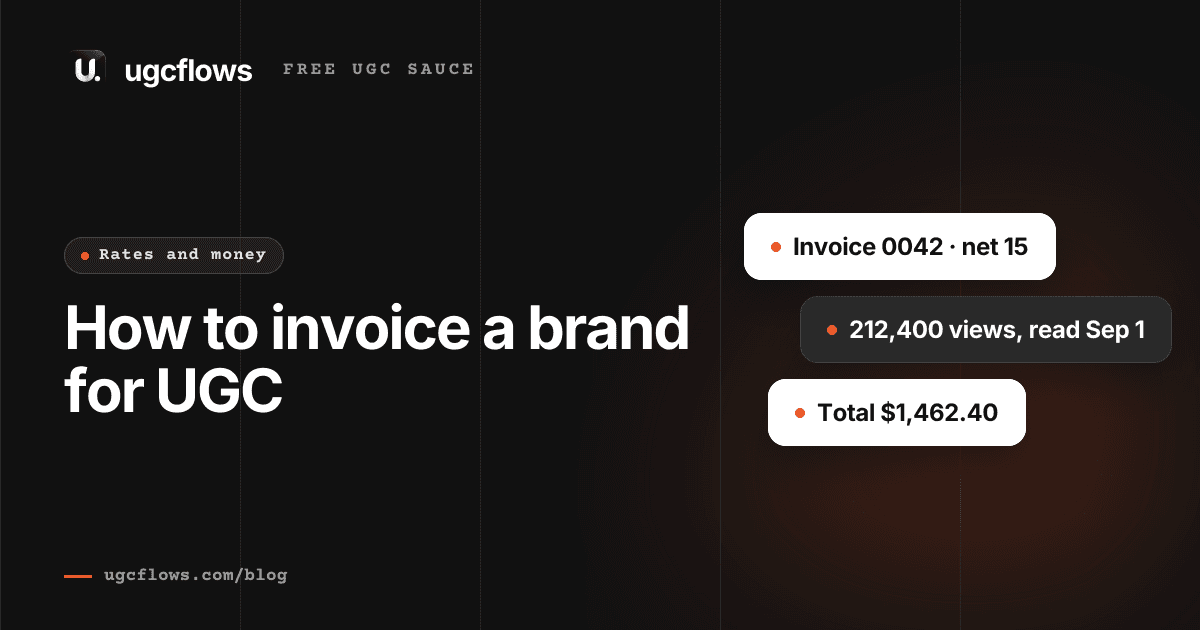
A UGC invoice is one line for the flat fee, one line per bonus rule carrying the view count and the date it was read, the usage rights, the total and the due date. Freeze the numbers on it; correct them on the next invoice, never by reissuing this one.
Key takeaways
- Eight things go on every invoice, in the same order every time, so the brand's finance team can pay it without a question.
- The bonus line carries the view count and the date it was read. A view count is a reading, not a fact.
- Never reissue a sent invoice. A correction is an adjustment line on the next one.
- Ask for net 15. Accept net 30 on retainers. Net 60 only with a deposit.
- UGC income is self-employment income in the US: file at $400 of net earnings, pay estimated tax quarterly, and owe it whether or not a 1099 arrives.
On this page
What goes on a UGC invoice?
The same eight things every time, in the same order, so the brand's finance team can pay it without a question. The two that UGC adds to an ordinary freelance invoice are the bonus line and the date on it. The rules that produce that line are in how much to charge for UGC.
- Your name or business name, address and email, and the brand's legal name and billing contact.
- An invoice number and the invoice date. Number them in sequence and never reuse one.
- The base line: how many cuts were delivered in the period, times the flat fee. A cut that went out on four platforms is one cut.
- One bonus line per rule: the rule in words ("$1 per 1,000 views, first 30 days, TikTok"), the views counted, the date they were read, and the amount.
- Usage rights, if they were priced separately, as their own line with the term.
- The total, the due date written as a date and not only as "net 30", and how to pay you.
Why the bonus line carries a date
A view count is a reading, not a fact: the same video says a different number tomorrow. So the bonus line says what the count was and when you read it, and that reading is what the brand is paying for. If a platform later reports more views inside the window, the difference goes on the next invoice as an adjustment line that names the earlier invoice number.
Which payment terms should you ask for?
For a deal with a bonus, agree the day the views are read on. A monthly invoice that reads views on the 1st and is due net 15 is a bill the brand can check on its own dashboard, which is what gets it paid on time.
| Terms | What it means | When to accept it |
|---|---|---|
| On delivery | paid when the cut is approved | small one-off deals, first deal with a brand |
| Net 15 | paid 15 days after the invoice date | the default to ask for |
| Net 30 | paid 30 days after the invoice date | retainers and larger brands, with the bonus period aligned to the month |
| Net 60 or longer | two months of float on your money | only with a deposit up front |
What about taxes?
In the US, UGC income is self-employment income. The IRS pages linked below say that if you have net earnings of $400 or more from self-employment you must file a return, that you generally pay estimated tax four times a year (April 15, June 15, September 15 and January 15), and that you owe tax on the income whether or not a brand sends you a 1099 form. Underpaying across the year draws a penalty even if you end up with a refund.
A common rule of thumb is to set aside a fixed share of every payment the day it lands, in an account you do not spend from. The share depends on your state and your other income. That is a rule of thumb and not tax advice; the IRS worksheet on Form 1040-ES is the actual calculation, and an accountant who does creator returns is worth one invoice a year.
How UGC Flows handles it
Every deal on the tracker carries its pay cycle and net terms, the app counts the views inside each rule's window, and a payout freezes the numbers as text the day it is logged. The taxes page shows the year by month and by brand on two bases, earned and paid, and exports both as CSV, with a set-aside rate you choose. It is on both plans, from $199 a month.
Reading this before the first invoice rather than after it? How to become a UGC creator is the part that comes first, and the rate calculator is what decides the number on the line.
Questions people ask
- How do I invoice for a view bonus that is still growing?
- Read the count on the agreed day, write the count and the date on the bonus line, and bill that. If the window is still open next month, the difference goes on the next invoice as an adjustment line that names this one.
- Do I need to pay quarterly taxes on UGC income?
- In the US, generally yes once you expect to owe tax on it. The IRS says self-employed people pay estimated tax four times a year, on April 15, June 15, September 15 and January 15, and that a return is required at $400 of net self-employment earnings.
- What if the brand never sends a 1099?
- You owe tax on the income anyway. The IRS is explicit that gig income is taxable whether or not an information form arrives, so keep your own record of every payment, which is what the paid side of a deal tracker is for.
How we know
The freeze rule is how the payout ledger on UGC Flows works: a payout row stores its numbers as text and is never recomputed, and a later scrape that backfills a missing day becomes an adjustment on a new row rather than a change to a bill already sent.
UGC Flows · published · last reviewed
Sources
Stop running your tech UGC business by hand.
The editing, the posting and the finances of a UGC business in one app, from $199 a month. Brand campaigns on Pro.
Get Flows